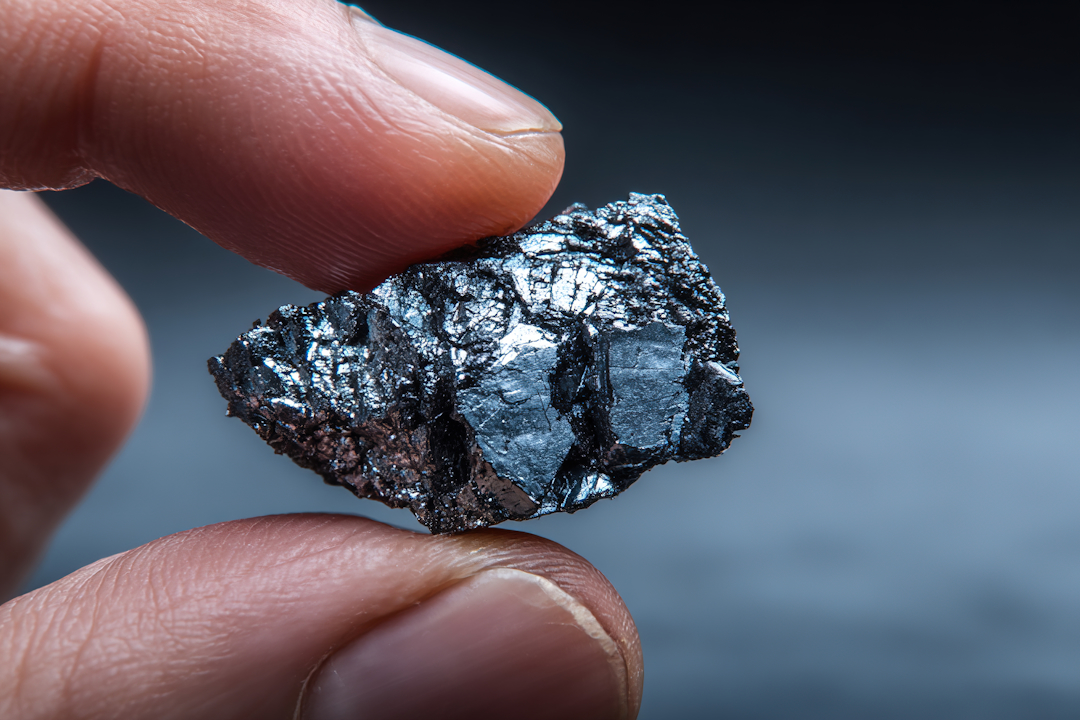
Lithium gets its name attached to the batteries that power electric vehicles, but graphite quietly makes up a far larger share of every battery cell by weight. Despite being less discussed than lithium, cobalt, or nickel, graphite carries the highest supply-risk score of any battery mineral according to recent policy analysis — and China’s dominance over it is, if anything, more extreme than its dominance over rare earths. Here is why graphite matters and why the market is entering a critical period.
The Short Answer
Graphite is the dominant material used in lithium-ion battery anodes — the component responsible for storing and releasing energy during charging. It represents roughly 95% of anode material in every battery cell by volume, making it the single largest material component in any lithium-ion battery. China controls an estimated 65-90% of global mining and processing, depending on the specific stage of the supply chain.
Why Graphite Matters So Much
While lithium gives lithium-ion batteries their name, and cobalt and nickel dominate headlines about cathode materials, it is graphite that makes up the anode — the negative electrode where lithium ions are stored during charging and released during discharge. According to AZoMining, 95% of the anode material in lithium-ion batteries is graphite, making it the biggest single component by volume in every battery cell manufactured today.
As electric vehicle adoption accelerates, graphite demand is following a similarly steep trajectory. Battery anode consumption of graphite is projected to grow from 28% of total graphite consumption in 2024 to 62% by 2036, according to a Global Graphite Market report, with overall graphite demand potentially rising 310% by 2036. The International Energy Agency projects battery-driven graphite demand could reach 6 to 30 times current levels by 2040.
Natural vs. Synthetic Graphite
Graphite used in batteries comes in two distinct forms, each with different cost, quality, and environmental tradeoffs:
- Natural graphite — mined directly from the ground in flake or vein form, then purified and processed into the spherical shape required for battery anodes. Generally lower cost and lower carbon footprint to produce, but with more variable quality depending on the deposit.
- Synthetic graphite — manufactured from petroleum coke or other carbon-based feedstocks through an energy-intensive high-temperature process. Offers higher purity and more consistent quality than natural graphite, but is significantly more expensive and energy-intensive to produce.
Most battery manufacturers actively blend natural and synthetic graphite in their anode formulations to balance cost, performance, and supply security — meaning the two forms are complementary rather than pure substitutes for each other.
China’s Extraordinary Dominance
China’s control over graphite is severe at every stage of the supply chain, though the exact figures vary depending on which specific stage is measured:
- Mining — China accounts for roughly 65-78% of global natural graphite mine output, depending on the source and year, with production reaching approximately 1.27 million metric tonnes in 2024 according to USGS data cited by the US Energy Information Administration
- Spherical graphite processing (the form required for battery anodes) — China controls an estimated 85-90% of global capacity, according to a Global Graphite Market report
- Synthetic graphite anode material — China controls more than 95% of global manufacturing capacity
- China is projected to control roughly 80% of battery-grade graphite production through 2035, according to Investing News Network — meaning this concentration is not expected to meaningfully ease anytime soon despite significant Western investment efforts
Export Controls and Trade Tensions
China has repeatedly used graphite export policy as a point of geopolitical leverage. In July 2025, the US Commerce Department responded by setting a preliminary anti-dumping duty of 93.5% on Chinese anode-grade graphite imports — an extraordinarily high tariff rate reflecting the scale of the trade dispute. China, in turn, introduced stricter end-user verification measures on graphite exports to the United States in 2024.
In a notable development, China’s Ministry of Commerce issued Announcement No. 72 on November 9, 2025, temporarily suspending those stricter verification measures and easing export licensing requirements for graphite shipments to the US, valid through November 27, 2026. According to Crux Investor, this eases immediate trade friction but does not resolve the underlying structural supply concentration, since the suspension itself is temporary and subject to renewal or reversal.
Oversupply and Price Weakness Despite Strong Demand
Somewhat counterintuitively, graphite prices have actually fallen even as demand has grown strongly. Graphite prices declined by an estimated 10-20% during 2024 despite demand growth of 6-8% that same year, according to the IEA’s Global Critical Minerals Outlook 2025, and prices fell a further average of 11% in 2025. The reason: China expanded its own processing capacity faster than near-term demand could absorb it, creating oversupply that compressed producer margins across the industry — including for Chinese producers themselves, whose profitability has come under pressure even as their market dominance persists.
Emerging Alternative Sources
Despite China’s overwhelming dominance, alternative graphite sources are slowly developing outside Asia, primarily in Africa. Mozambique, Madagascar, and Tanzania form a smaller second tier of natural graphite production. Mozambique in particular is projected to grow production nearly seven-fold to 247,500 tonnes in 2025, following the restart of Syrah Resources’ Balama project — one of the most closely watched non-Chinese graphite projects globally. Sovereign Metals’ Kasiya project in Malawi is another frequently cited example of a non-Chinese, geopolitically neutral graphite development effort, according to Crux Investor.
Key Takeaways for Investors
- Graphite is the dominant material in lithium-ion battery anodes, representing roughly 95% of anode material by volume — the largest single material in every battery cell
- China dominates every stage of the graphite supply chain: mining (65-78%), spherical graphite processing (85-90%), and synthetic graphite manufacturing (95%+)
- Natural and synthetic graphite are complementary, not purely substitute materials — most manufacturers blend both in anode formulations
- The US imposed a 93.5% anti-dumping duty on Chinese anode-grade graphite in July 2025; China has used export controls and temporary suspensions as points of leverage
- Graphite prices have fallen despite strong demand growth, due to China’s own processing capacity expanding faster than near-term demand
- Emerging non-Chinese sources include Mozambique (Syrah Resources’ Balama project), Madagascar, Tanzania, and Malawi (Sovereign Metals)
SOURCES
1. GlobeNewswire — Global Graphite Market 2026-2036: https://www.globenewswire.com/de/news-release/2025/10/07/3162274/0/en/Global-Graphite-Market-2026-2036-Graphite-Demand-is-Projected-to-Rise-310-by-2036-with-Battery-Anodes-Growing-from-28-of-Consumption-in-2024-to-62-by-2036.html
2. Crux Investor — China’s Temporary Easing of Graphite Export Controls: https://www.cruxinvestor.com/posts/chinas-temporary-easing-of-graphite-export-controls-the-shifting-global-supply-outlook-for-battery-materials
3. Investing News Network — Graphite Market Forecast: Top Trends for 2026: https://investingnews.com/daily/resource-investing/battery-metals-investing/graphite-investing/graphite-forecast/
4. Metalshub — Graphite Supply Chain in 2026: Risks and Opportunities: https://www.metals-hub.com/en/blog/graphite-supply-chain/
5. AZoMining — Graphite Mining: Key Trends and Challenges in 2026: https://www.azomining.com/Article.aspx?ArticleID=1944
DISCLAIMER
This article is an educational explainer based on publicly available industry data, market research, and published analyst commentary. Information was current as of the publication date noted below. Commodity price data and forecasts are sourced as cited and reflect market conditions at the time of writing.
Mining Markets Report has not received compensation from any company, institution, or organization in connection with this article.
Institutional price forecasts and analyst commentary referenced in this article represent third-party opinions at the time of publication and are not guarantees of future commodity performance.
The information provided is for informational and educational purposes only and does not constitute financial, investment, or professional advice. Readers are encouraged to conduct their own due diligence and consult a qualified financial advisor before making any investment decision.
For full terms, see our Disclaimer.