Every headline resource figure in a mining press release — “2 million ounces of gold” or “500 million pounds of copper” — is the output of a specific technical process called mineral resource estimation. Understanding how that number is actually produced, and why it can change significantly between updates, is one of the more technical but genuinely valuable things an investor can learn about how mining companies communicate the value of what’s in the ground.
The Short Answer
A mineral resource estimate is a statistical calculation of the quantity and grade of a mineral deposit, built from drilling and sampling data using geostatistical methods. The core technique is called block modeling — dividing the deposit into a three-dimensional grid of blocks and estimating the grade of each one based on nearby drill hole samples.
Where the Process Starts: Drilling Data
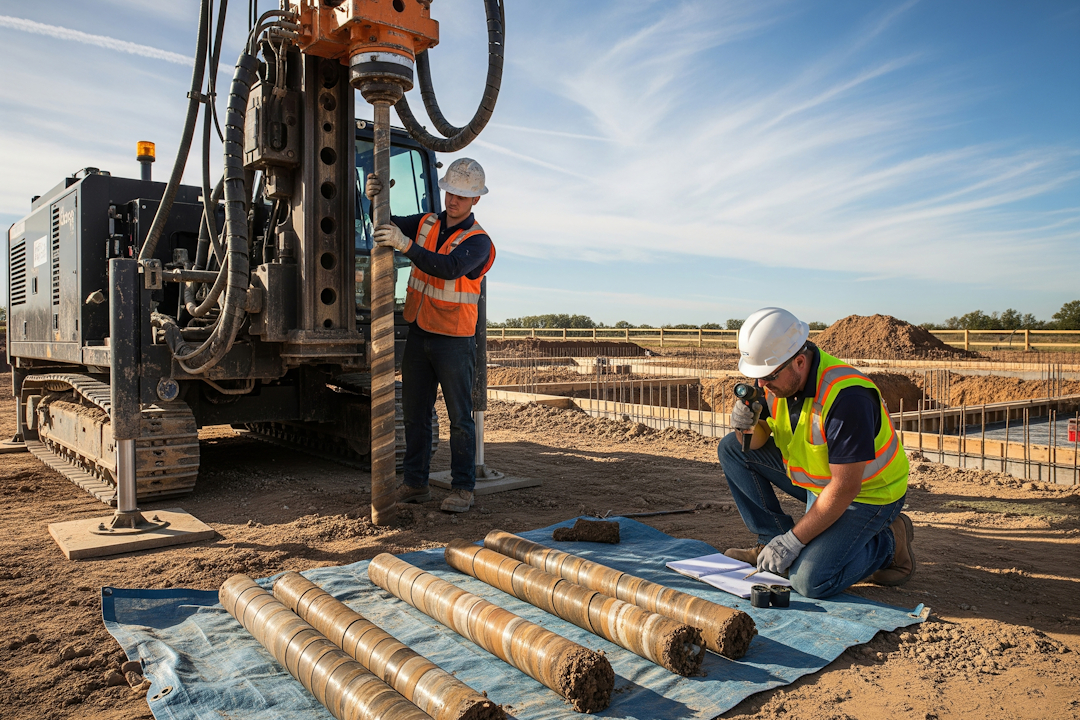
Resource estimation begins with data. Geologists collect samples from exploration drill holes across the deposit, sending them to a laboratory for assay — a chemical analysis measuring the concentration of the target mineral at each sampled interval. This raw drilling data forms the foundation for everything that follows; a resource estimate is only as reliable as the density, quality, and spatial distribution of the drill hole data underlying it.
Building the Geological Model
Before any statistical estimation happens, geologists build a three-dimensional geological model of the deposit — interpreting the drill hole data alongside surface topography, geological structure, and rock type (lithology) to spatially map out where the mineralized zone actually sits within the surrounding rock. This interpretive step matters enormously: a geological model that misreads the structural controls on mineralization can lead to a resource estimate that looks statistically sound but is fundamentally wrong about where the ore actually is.
The Block Model: The Heart of Resource Estimation
Once the geological model is built, geologists divide the deposit into a three-dimensional grid of “blocks” — think of it as a giant set of Lego blocks stacked together, with each individual block assigned its own estimated grade, rock type, density, and confidence level, according to Mining Explained. Block dimensions are not arbitrary; they are typically set based on the average drill hole spacing, the geological continuity of the mineralization, and the intended mining method — a project planned for selective underground mining generally uses smaller blocks than one planned for bulk open pit extraction.
Geostatistics: How Grades Are Actually Estimated
With the block model framework in place, geostatistical methods are used to estimate the grade of each individual block based on the grades measured in nearby drill hole samples. This typically involves two key steps: first, variogram modeling, which statistically analyzes how grade values change with distance and direction across the deposit, quantifying the spatial “continuity” of the mineralization. Second, an interpolation method — most commonly a technique called kriging — uses those variogram relationships to calculate the most statistically likely grade for each block, weighted by the distance, direction, and reliability of nearby sample data.
Why Confidence Levels Differ: Inferred, Indicated, Measured
As covered in our NI 43-101 and JORC explainers, every block in the model is also assigned a confidence classification — Inferred, Indicated, or Measured — based primarily on drill hole density and data quality in that specific area of the deposit. A block surrounded by widely spaced, sparse drilling receives a lower-confidence classification; a block surrounded by dense, closely spaced, high-quality drilling receives a higher-confidence classification. This is why a single deposit frequently contains a mix of all three resource categories simultaneously — the parts that have been drilled extensively are Measured or Indicated, while the less-drilled periphery remains Inferred.
Why Resource Estimates Change Over Time
Resource estimates are not static, one-time calculations — they evolve continuously as additional exploration data becomes available. A maiden (first-ever) resource estimate typically shows high uncertainty, with resources classified predominantly as Inferred. Subsequent updates, incorporating additional drilling, typically show increasing confidence as previously Inferred material migrates into the Indicated and Measured categories — while total resource tonnage may increase or decrease as the geological picture becomes clearer.
The Qualified Person’s Role
Under NI 43-101 (and equivalently under JORC’s Competent Person requirement, covered in our JORC explainer), a Qualified Person must directly prepare or supervise the resource estimate and take formal responsibility for the results before they can be publicly disclosed. According to CIM guidelines, the choice of block size, search parameters, and estimation methodology all require professional justification and documentation, and the resulting block model must be validated against the original drilling data to confirm the estimate reasonably reflects reality rather than an artifact of the chosen statistical parameters.
Known Limitations and Sources of Error
Resource estimation is a powerful tool, but it is fundamentally an interpretation based on limited data, and this “conceptual uncertainty” can be genuinely difficult to quantify. According to Diversification.com, significant resource downgrades between updates have occurred in the industry — sometimes attributed to insufficient integration of structural geological knowledge into the original model — and these downgrades can meaningfully damage investor confidence when they happen. Critics also note that resource classification retains an inherently subjective element: while public reporting codes provide guidelines, the ultimate classification judgment rests with the Qualified Person or Competent Person, and parameters like drill-hole spacing thresholds or acceptable kriging variance can genuinely differ between different estimators, even for similar deposit types.
Why This Matters for Investors
A resource estimate is the fundamental input for virtually all subsequent economic analysis of a mining project — as covered in our feasibility study explainer, PEAs, pre-feasibility studies, and feasibility studies are all built on top of the underlying resource estimate. It also directly informs mine planning, determines the economically optimal cut-off grade (the minimum grade worth extracting), and underpins the resource and reserve figures that companies use to raise capital and attract investment. Understanding that these numbers are statistical estimates — subject to real uncertainty and genuine potential for revision — rather than a precise, fixed inventory of metal in the ground is an important part of reading any mining company’s disclosures with appropriate skepticism.
Key Takeaways for Investors
- Mineral resource estimates are statistical calculations built from drilling and assay data, not a precise physical inventory of what’s in the ground
- The block model — dividing a deposit into a 3D grid of blocks, each with its own estimated grade — is the core technical framework used
- Geostatistical techniques, particularly variogram modeling and kriging, are used to estimate the grade of each block from nearby drill samples
- Resource confidence classification (Inferred, Indicated, Measured) reflects drill hole density and data quality, and typically improves with additional drilling over time
- A Qualified Person or Competent Person must prepare or supervise every resource estimate and take formal professional responsibility for the results
- Resource estimates carry genuine interpretive uncertainty and can be revised significantly — including downgraded — as new data becomes available
SOURCES
1. Discovery Alert — How to Complete a Mineral Resource Estimate in Five Steps: https://discoveryalert.com.au/technical-foundation-resource-quantification-2026/
2. Wikipedia — Mineral Resource Classification: https://en.wikipedia.org/wiki/Mineral_resource_estimation
3. Mining Explained — The Mineral Resource Estimate: https://miningexplained.com/the-mineral-resource-estimate/
4. CIM — Estimation of Mineral Resources and Mineral Reserves Best Practice Guidelines: https://mrmr.cim.org/media/1146/cim-mrmr-bp-guidelines_2019_may2022.pdf
5. Diversification.com — Mineral Resource Estimation: Meaning, Criticisms & Real-World Uses: https://diversification.com/term/mineral-resource-estimation
DISCLAIMER
This article is an educational explainer based on publicly available industry data, market research, and published analyst commentary. Information was current as of the publication date noted below. Commodity price data and forecasts are sourced as cited and reflect market conditions at the time of writing.
Mining Markets Report has not received compensation from any company, institution, or organization in connection with this article.
Institutional price forecasts and analyst commentary referenced in this article represent third-party opinions at the time of publication and are not guarantees of future commodity performance.
The information provided is for informational and educational purposes only and does not constitute financial, investment, or professional advice. Readers are encouraged to conduct their own due diligence and consult a qualified financial advisor before making any investment decision.
For full terms, see our Disclaimer.