Highlights
- SAGA Metals Corp. (TSXV: SAGA; OTCQX: SAGMF; FSE: 20H) has completed 22 diamond drill holes totaling 3,241 meters at its Wolverine Heavy Rare Earth Element Project in Labrador, the first systematic diamond drilling on the property.
- On-site visual logging identified alteration the company associates with rare earth mineralization in all 22 holes; only two holes have been fully logged and sampled so far.
No assay results have been received, so the presence and grade of rare earths in this drilling remain unconfirmed.
SAGA Metals Corp. (TSXV: SAGA; OTCQX: SAGMF; FSE: 20H) reported on October 21, 2026, in a release distributed via PRNewswire, that it has wrapped up its first diamond drill program at the Wolverine Heavy Rare Earth Element Project in Labrador. Twenty-two holes, 3,241 meters in total. Every one of them, according to SAGA, cut through the kind of altered rock it links to rare earth mineralization.
The catch? Nobody has seen a lab result yet.
What “Alteration” Means Here
Alteration is what happens when hot fluids move through rock and change its chemistry. Geologists track it because those same fluids can carry metals and drop them along the way. At Wolverine, SAGA is targeting chlorite-dominant (propylitic) alteration, laced with sulfide and carbonate veins, which it believes hosts the rare earths.
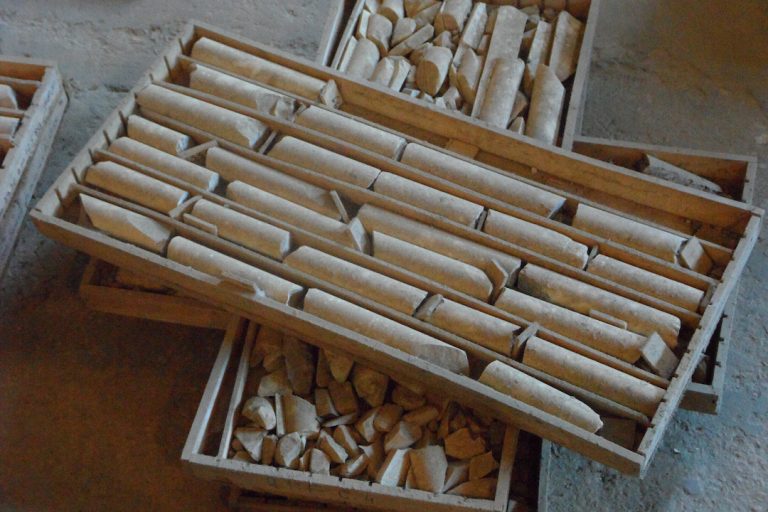
Finding that signature in core is encouraging. It is also a visual call made by the on-site geologist. It cannot show how much rare earth is present, or whether there is enough to matter economically. Assays answer that.
Two Holes Logged, Twenty to Go
All 22 holes were drilled steeply, at minus 85 degrees, to depths between 43 and 204 meters. Only two have been fully logged and sampled:
- W26-001 went to 182 meters and hit 118.75 meters of the target Unit 4 ash tuff. Alteration was logged from 1.8 meters down to the bottom of the hole. Crews took 138 core samples.
- W26-002 reached 179 meters, with 50.97 meters of Unit 4 and alteration logged from 0.35 meters almost to the end. It yielded 139 samples.
Logging of the other 20 holes is underway. SAGA plans to release assays in batches but gave no date.
Crews also spent two months prospecting elsewhere on the property and collected 136 grab samples, with assays pending. The company says the target volcanic units turned up in several locations and that new pegmatites and aplite dykes were found in the south. Grab samples are hand-picked from surface rock and tend to favor the best-looking material, so they say little about average grade.
The Historical Numbers
SAGA’s project summary cites historic drilling at Wolverine with assays up to 2.03% total rare earth oxide (TREO), roughly 28% of it heavy rare earth oxide, plus a pegmatite grab sample that returned 21.6% TREO. These results come from earlier work, not this program. The release does not detail their source or how they were verified. The grab result is selective by nature, and none of these figures is a current Mineral Resource. There is no resource estimate for the project under NI 43-101, the Canadian standard for reporting mineral projects.
Why the heavy rare earth share gets attention: elements such as dysprosium and terbium help permanent magnets hold up at high temperatures in EV motors and wind turbines. They are scarcer than light rare earths, and China dominates their processing. That is a big reason Canada and the U.S. treat them as critical minerals.
Big Comparisons, Early Days
Michael Garagan, a director and the Chief Geological Officer, said the program confirmed the target alteration in every hole and will shape both the 2027 exploration plan and a planned maiden Mineral Resource Estimate. He also named a longer-range goal: showing that the Flowers River Igneous Suite at Wolverine can rival Torngat Metals’ Strange Lake project in Quebec and Critical Metals Corp.’s Tanbreez project in Greenland.
Both of those projects have years of drilling and study behind them. Wolverine has its first set of diamond holes and no assays. For now, the comparison is a stated ambition.
The technical information in the release was reviewed and approved by Dr. A. Miller, P.Geo., whom the company identifies as an independent Qualified Person under NI 43-101.
What’s Next
SAGA will finish logging, ship the remaining samples to the lab and update its geological model. An induced polarization (IP) survey, a ground geophysics method that can pick up sulfide-bearing rock below surface, is planned for the second quarter of 2027. SAGA expects the IP data and assays together to guide follow-up drilling aimed at the deeper roots of the mineralizing system. Those timelines are forward-looking and could shift.
Until the assays land, the grade question stays open.
Sources
Editorial Disclosure
This article is based on a corporate press release issued by SAGA Metals Corp. on October 21, 2026, and distributed via PRNewswire. Securities discussed: SAGA Metals Corp. (TSXV: SAGA | OTCQX: SAGMF | FSE: 20H). Mining Markets Report has not received compensation from SAGA Metals, its management, investor relations representatives, or any third party for the creation of this specific coverage. No staff member, principal, or affiliate of Mining Markets Report holds a position, option, or interest in this security as of the publication date. Drilling observations described in this article are based on visual core logging only; assay results are pending and have not been received or verified. Historical drill results and grab samples referenced are selective, may not be representative of mineralization on the property, and do not constitute a current Mineral Resource or Mineral Reserve estimate. Statements regarding assay reporting, the planned Q2 2027 induced polarization survey, follow-up drilling, and a maiden Mineral Resource Estimate are forward-looking statements. They are subject to operational risks, geological uncertainties, and regulatory approvals; actual outcomes and timing may differ materially. Mineral exploration and junior mining stocks carry an extremely high degree of financial risk. Early-stage exploration companies often have no revenues, are speculative in nature, and can result in the total loss of invested capital. This overview is published strictly for informational, news-reporting, and educational market context purposes only. It does not constitute an investment recommendation, endorsement, or professional financial, legal, or tax advice.
For further details regarding our editorial independence, publishing policies, and full risk disclaimers, please see our full Terms & Disclaimers Page