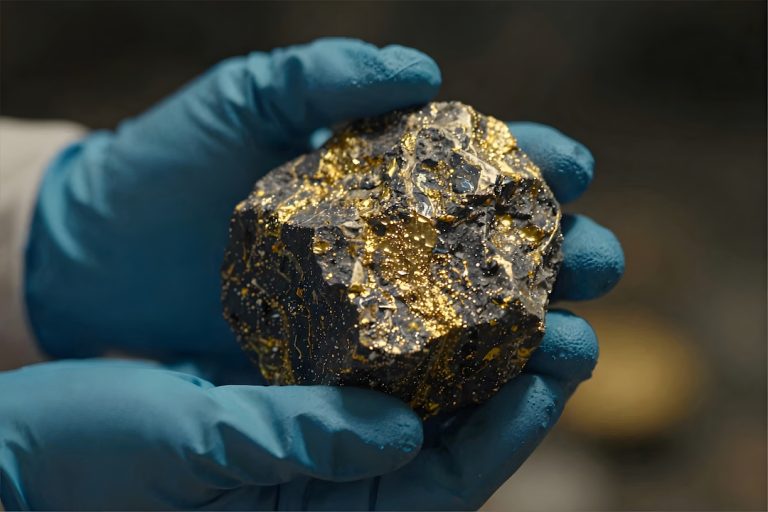
Perpetua Resources Corp. (Nasdaq: PPTA; TSX: PPTA) reported new drilling results on August 6, 2026 from its Stibnite Gold Project in central Idaho, the company’s first exploratory drilling program in nearly a decade at the site. The results include several high-grade gold and antimony intercepts near the project’s existing permitted mining pits, along with a newly identified zone containing tungsten, a metal not currently part of Perpetua’s mine plan but one the U.S. government has flagged as a critical mineral in short domestic supply.
What the Drilling Found
The strongest results came from what the company calls the Clark Tunnel Fault Zone, a newly defined area along the edge of the planned Yellow Pine pit. One hole, SB597, returned 21.3 meters grading 3.2 grams per tonne gold and 0.9% tungsten, including a higher-grade section of 7.0 meters at 7.1 g/t gold and 0.3% tungsten. Another hole in the same zone, SB580, returned 6.4 meters at 16.2 g/t gold and 1.7% antimony starting at surface, among the highest grades reported. At the company’s Hangar Flats deposit, hole SB584 returned 3.0 meters at 14.5 g/t gold, and separate antimony-and-tungsten-focused drilling there returned intervals as rich as 8.3% antimony and 4.6% tungsten over several meters. A third target area, the Huckleberry Fault Zone adjacent to the Yellow Pine pit, returned lower-grade but notably wide intervals, including 69.6 meters at 0.8 g/t gold in one hole, suggesting a broad zone of mineralization the company will likely follow up on.
Grade and width figures like these describe individual drill intercepts, not a defined, minable resource; the company notes true widths are estimated at roughly 85 to 95% of the reported interval lengths, and cautions that isolated results don’t by themselves prove a mineral deposit exists. The company said these new results point to further upside beyond the 3.1 million ounces of indicated and inferred gold resources and 99.8 million pounds of antimony resources already identified outside its current mine plan.
The Tungsten Angle
Tungsten is the more unusual thread in this release. Stibnite has a documented history as a tungsten source, having supplied roughly half of all U.S. tungsten consumption during World War II and the Korean War, according to Perpetua, before U.S. tungsten production largely shifted to reliance on Chinese imports in the decades since. China has produced an estimated 80% of the world’s tungsten in recent years, and the company notes that Chinese export restrictions imposed in February 2025 on tungsten and antimony pushed tungsten prices up more than 500% from 2024 lows. Both metals are officially designated as critical minerals by the U.S. government due to their use in defense applications, and tungsten in particular is prized for retaining strength at extreme temperatures and hardness, though most tungsten demand actually comes from industrial cutting tools rather than weapons systems.
Perpetua has submitted a funding proposal to U.S. government agencies to support additional tungsten drilling, sampling, and metallurgical testing at Hangar Flats, layered on top of its existing 10,000-meter 2026 drilling program. The company is explicit that no funding has been committed and there’s no guarantee the proposal will be approved or that economically recoverable tungsten will ultimately be confirmed; this is an early-stage exploration angle, not a confirmed second (or third) product line for the mine.
What’s Next
Perpetua has completed roughly 5,800 of a planned 10,000-plus meters of 2026 core drilling, using four rigs, with results still pending assay for a portion of that work. Some of the targets identified, including areas outside the currently permitted mine plan, would require additional environmental review and permitting before any mining could occur there, a process that has historically taken years for projects like this one. CEO Jon Cherry framed the exploration priority as testing higher-grade targets that could extend the mine’s current estimated production run beyond its first four years, which the company’s technical report projects at an average of 463,000 gold ounces annually.
Sources
Editorial Disclosure
This article is based on a press release issued by Perpetua Resources Corp. on August 6, 2026, distributed via PRNewswire. Securities discussed: Perpetua Resources Corp. (Nasdaq: PPTA; TSX: PPTA). Mining Markets Report has not received compensation from Perpetua Resources, its management, investor relations representatives, or any third party for this coverage. No staff member or principal of Mining Markets Report holds a position in this security at the time of publication. Drill intercept grades and widths reported here are individual exploration results and do not by themselves establish a mineral resource or reserve; true widths are estimated by the company and may differ from reported interval lengths. Statements regarding potential expansion of gold and antimony resources, tungsten exploration and potential grant funding, future drilling plans, and permitting outcomes are forward-looking and involve known and unknown risks; there is no assurance that further drilling will confirm an economic resource, that grant funding will be awarded, or that any additional mining areas will receive regulatory approval. Historical production and market figures regarding tungsten and antimony, including pricing and export-restriction impacts, are as characterized in the source release and have not been independently verified by Mining Markets Report. References to this company are for market context and analytical purposes only and do not constitute an investment recommendation. All securities carry investment risk including possible loss of capital. Coverage on Mining Markets Report is for informational and educational purposes only; Mining Markets Report is not a registered investment advisor. Readers should conduct their own due diligence and consult a qualified financial advisor before making investment decisions.
See our full DISCLAIMER.