Highlights
- IMC Rare Earths Ltd (NYSE American: IMC) reported 7 meters at 5,695 ppm TREO, 38 ppm Tb4O7 and 258 ppm Dy2O3, starting two meters below surface, in auger hole AD-00555 at Block H of its Itarantim project in Brazil.
- Initial ammonium sulfate leach tests recovered 64% to 83% of the terbium from the upper three meters of the enriched zone.
- The result comes from a single hole outside the existing 1.1-billion-tonne Inferred Mineral Resource; no resource has been estimated for Block H, and the Qualified Person is a company Director.
IMC Rare Earths Ltd (NYSE American: IMC) said on October 8, 2026, in a release distributed via PRNewswire, that the first hole drilled at Block H of its Itarantim project in Brazil hit shallow, terbium-rich clay. Block H had never been drilled before. It also sits outside the company’s existing resource.
Terbium is why this gets attention. Manufacturers add small amounts of it to permanent magnets so they hold their strength when hot, which matters in electric vehicle motors and wind turbines. China controls most supply and now requires export licenses for certain terbium and yttrium products. New sources elsewhere are scarce.
One Hole, Starting at Two Meters
Auger hole AD-00555 went straight down to 16 meters. Mineralization began two meters below surface and ran for seven meters, grading 5,695 parts per million (ppm) total rare earth oxides (TREO), 38 ppm terbium oxide (Tb4O7) and 258 ppm dysprosium oxide (Dy2O3).
The best stretch, from four to seven meters, graded 7,841 ppm TREO, 52 ppm Tb4O7 and 357 ppm Dy2O3. One single-meter sample returned 58 ppm Tb4O7. Because the hole is vertical, the company says the intervals approximate true thickness.
Dysprosium and terbium oxides make up 5.2% of TREO in the interval. That share counts for more than the headline TREO grade. These two heavy rare earths typically sell for many times the price of the lighter elements that dominate most clay deposits.
CEO and Chair Frank Scolaro was direct about the limits. “One hole does not tell us how large this new zone may be,” he said, adding that the immediate goal is to keep drilling.
Why Clay Deposits Draw Interest
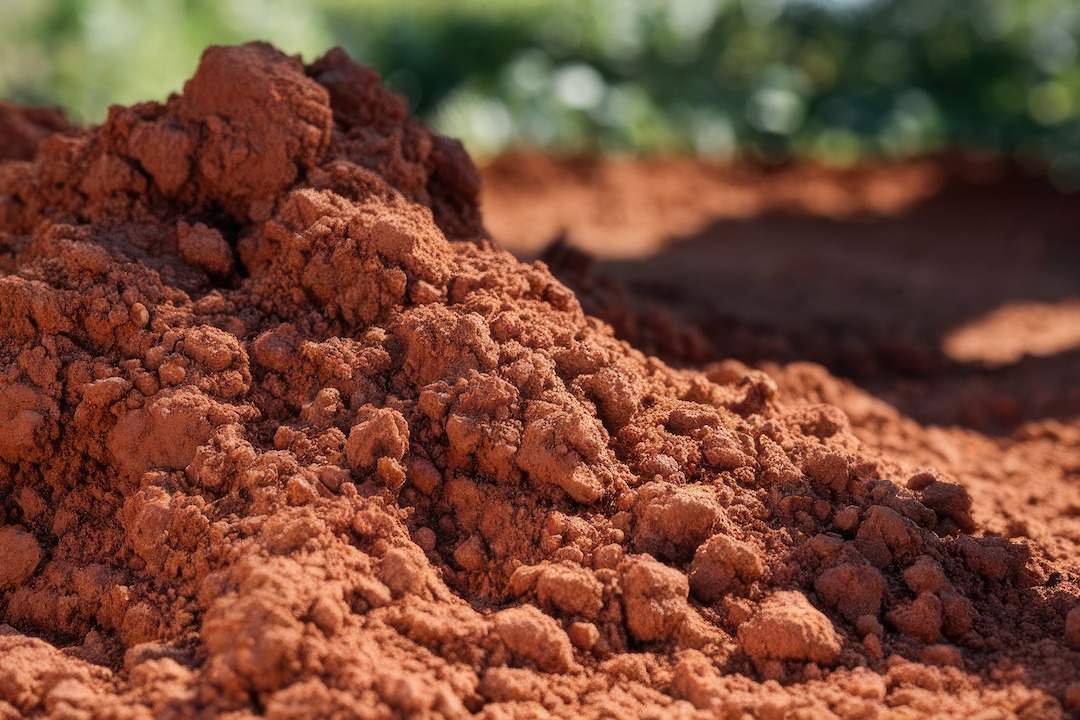
Ionic adsorption clay deposits hold rare earths loosely attached to clay particles in weathered rock near surface. Producers can often wash the metals out with a salt solution instead of crushing hard rock. Much of southern China’s heavy rare earth output comes from this deposit style, and several Brazilian projects are chasing the same model.
Initial ammonium sulfate leach tests recovered 64% to 83% of the terbium from the upper three meters at Block H. These are early laboratory results. IMC states it has not established that its exploration grades or lab extraction figures will translate into commercially recoverable products, and no economic study covers Block H.
Block D and the Bigger Picture
A second target, Block D, returned 20 meters at 4,098 ppm TREO and 24 ppm Tb4O7 from seven meters depth in hole AD-00403, including six meters at 6,574 ppm TREO and 42 ppm Tb4O7. A nine-meter section from 14 to 23 meters averaged 72% terbium extraction in leach tests. The hole ended still in mineralization. Auger rigs reach only about 30 meters, so diamond drilling comes next.
Itarantim’s 1.1-billion-tonne resource is classified entirely as Inferred, the lowest-confidence category, at a 650 ppm TREO cut-off, according to the company’s SEC filings. It is reported under S-K 1300, the SEC’s mining disclosure rules for US-listed issuers and the American counterpart to Canada’s NI 43-101. The Block H and Block D extensions have no resource at all. IMC calls them conceptual exploration targets.
What Happens Next
IMC plans infill and step-out drilling around AD-00555, leach testing on every mineralized sample, and column leach testwork. At Block D, diamond holes will test the zone below auger depth and up-slope, where the company interprets it to thicken.
The company is also picking an engineering firm to study vat, heap and in-situ leaching, with metallurgical work at ANSTO in Australia. An updated resource estimate is expected later in 2026. It will include infill drilling at Block A aimed at moving parts of the resource into the Indicated category.
The technical information was approved by Alexandre Rocha da Rocha, MSc, a Qualified Person under S-K 1300. He is a Director of IMC and, per the release, is not independent of the company.
Sources
- IMC Rare Earths Ltd: IMC Rare Earths Discovers New High-Grade, Near-Surface Terbium Zone Beyond Existing 1.1 Billion Tonne Resource at Block H, Itarantim, PRNewswire, October 8, 2026
- IMC Rare Earths Ltd: Form 6-K, Exhibit 99.1 (Cautionary Note on Inferred Mineral Resources), U.S. Securities and Exchange Commission
Editorial Disclosure
This article is based on a corporate press release issued by IMC Rare Earths Ltd on October 8, 2026, and distributed via PRNewswire. Securities discussed: IMC Rare Earths Ltd (NYSE American: IMC). Mining Markets Report has not received compensation from IMC Rare Earths, its management, investor relations representatives, or any third party for the creation of this specific coverage. No staff member, principal, or affiliate of Mining Markets Report holds a position, option, or interest in this security as of the publication date. Statements regarding the potential size, grade, and continuity of mineralization at Block H and Block D, leach recovery results, planned drilling and metallurgical work, and an updated Mineral Resource estimate expected later in 2026 are forward-looking statements. They are subject to geological uncertainties, metallurgical risks, and regulatory approvals; actual outcomes and timing may differ materially. The Itarantim Mineral Resource is classified entirely as Inferred, and the Block H and Block D exploration targets are conceptual in nature and do not represent a mineral resource or mineral reserve. The Qualified Person who approved the technical information is a Director of IMC Rare Earths and is not independent of the company. Mineral exploration and small-cap mining stocks carry an extremely high degree of financial risk. Exploration-stage companies often have no revenues, are speculative in nature, and can result in the total loss of invested capital. This overview is published strictly for informational, news-reporting, and educational market context purposes only. It does not constitute an investment recommendation, endorsement, or professional financial, legal, or tax advice.
For further details regarding our editorial independence, publishing policies, and full risk disclaimers, please see our full Terms & Disclaimers Page