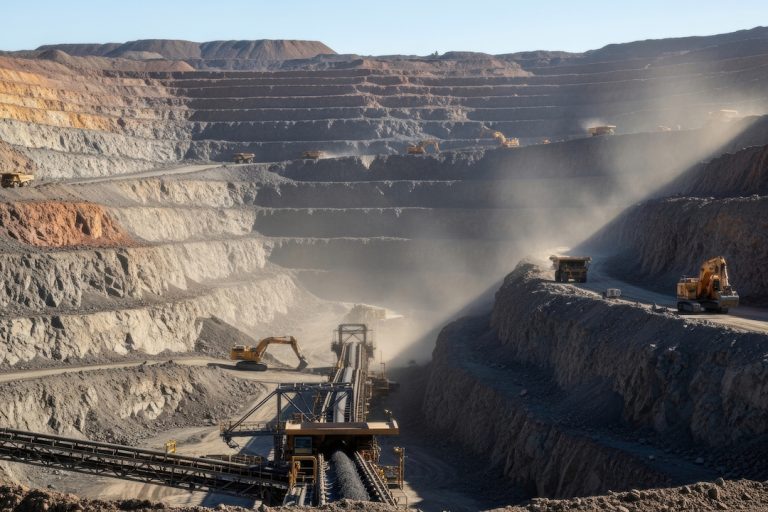
i-80 Gold Corp. (NYSE American: IAUX; TSX: IAU) has changed the order in which it plans to build out its Nevada pipeline. In a development update issued October 14, 2026, via PRNewswire, the company said its Mineral Point open pit will be the next major build once its underground mining and processing platform is running. Behind it now sits Granite Creek open pit. Cove underground moves later still.
Highlights
- i-80 Gold Corp. (NYSE American: IAUX; TSX: IAU) says Archimedes underground remains on track to begin production mining in Q4 2026, with the Lone Tree plant targeting a first gold pour in Q4 2027.
- The updated development plan moves Mineral Point open pit ahead of Granite Creek open pit and pushes Cove underground later in the sequence.
Only Granite Creek underground has declared mineral reserves; the other production targets rest on preliminary studies that partly use Inferred resources.
The near-term work hasn’t changed. Archimedes underground is still slated to start production mining this quarter, and the Lone Tree plant refurbishment is still aiming for a first gold pour in the fourth quarter of 2027.
Why the Sequence Changed
It comes down to feed. Once refurbished, Lone Tree is meant to serve as a central processing hub for i-80’s underground mines, a setup the company calls hub-and-spoke. i-80 now believes Granite Creek underground and Archimedes underground can keep the plant supplied for longer than it first assumed.
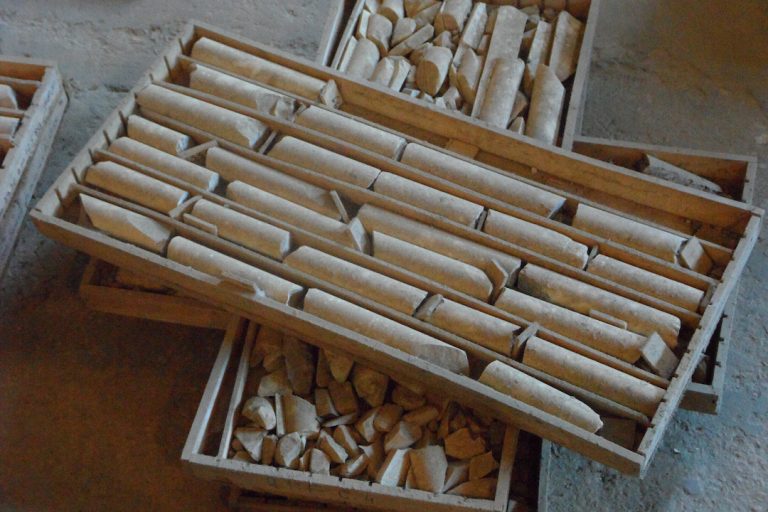
Granite Creek is the main exhibit. Its Measured and Indicated resources, the two higher-confidence resource categories, rose about 230% in a September 2026 feasibility study compared with the March 2025 preliminary economic assessment (PEA). At Archimedes, drilling keeps hitting oxide mineralization outside the earlier resource model.
If those two mines can carry Lone Tree, Cove can wait. That opens the door for Mineral Point.
The Case for Mineral Point
Mineral Point is a large gold-silver oxide deposit planned as an open pit heap leach operation. Heap leaching stacks crushed ore on lined pads and trickles a solution through it to dissolve the metal. It is usually cheaper than milling and suits oxide ore.
The March 2025 PEA outlined potential output of roughly 280,000 gold equivalent ounces a year over a 17-year mine life. This update doesn’t restate the metal prices or recoveries behind that gold-equivalent figure, so it shouldn’t be lined up against other companies’ equivalent numbers. PEAs are early-stage studies and can lean partly on Inferred resources, the lowest-confidence category.
Timing hasn’t moved from the PEA. A pre-feasibility study is targeted for around mid-2027, pending drilling. Separately, i-80 has opened talks with its lead lenders on a corporate revolving credit facility for extra liquidity, if needed.
Lone Tree Is the Linchpin
Right now, i-80 pays third parties to process its ore, an arrangement known as toll milling. The company expects owning its own plant to lift cash margins by $1,000 to $1,500 per ounce, depending on grade and gold price.
Lone Tree runs an autoclave, a pressurized vessel that breaks down sulfide, or “refractory,” ore so the gold can be recovered. These are scarce. i-80 says the only other gold company with autoclave capacity in Nevada is Nevada Gold Mines, the Barrick-Newmont joint venture.
Spending is tracking close to plan. The December 2025 engineering study put total capital at $430 million, including roughly 12% contingency. About 10% of that contingency has been drawn, and around 44% of capital was committed by the end of September. Labor costs are running 5% to 10% over estimate in a tight Northern Nevada job market, which the company says still fits within contingency.
Over at Archimedes, on the Ruby Hill property, i-80 is testing whether more oxide material from the 426 zone could go onto the existing heap leach pad instead of through Lone Tree. Recoveries haven’t been established. Extraction there began without declared mineral reserves.
Reading the Production Targets
i-80 is targeting 150,000 to 200,000 ounces of gold a year from 2028, with the two underground mines feeding Lone Tree. Mineral Point would lift that to 400,000 to 500,000 ounces from 2031. Adding Granite Creek open pit takes the goal to 500,000 to 600,000 ounces in the early 2030s, with Cove later helping hold that level.
By i-80’s own description, these are goals and shouldn’t be read as output guidance. Every tier depends on Lone Tree being commissioned, and everything beyond Granite Creek underground rests on studies that use Inferred resources in part.
The release’s technical content was approved by Paul Chawrun, P.Eng., i-80’s Executive Vice President and Chief Operating Officer. He serves as qualified person under NI 43-101 and S-K 1300, the Canadian and U.S. disclosure standards. He holds an officer role at the company and is not an independent consultant.
Sources
Editorial Disclosure
This article is based on a corporate press release issued by i-80 Gold Corp. on October 14, 2026, and distributed via PRNewswire. Securities discussed: i-80 Gold Corp. (NYSE American: IAUX | TSX: IAU). Mining Markets Report has not received compensation from i-80 Gold, its management, investor relations representatives, or any third party for the creation of this specific coverage. No staff member, principal, or affiliate of Mining Markets Report holds a position, option, or interest in this security as of the publication date. Production targets, development timelines, capital cost estimates, margin expectations, and resource expansion potential described here are forward-looking statements. They are subject to operational risks, geological and metallurgical uncertainties, permitting, financing, and commodity price volatility; actual outcomes and timing may differ materially. Mineral resources that are not mineral reserves do not have demonstrated economic viability. Other than Granite Creek underground, the projects discussed are considered exploration stage under S-K 1300, and the qualified person who approved the release’s technical information is an officer of the company. Mining stocks carry a high degree of financial risk and can result in the loss of invested capital. This overview is published strictly for informational, news-reporting, and educational market context purposes only. It does not constitute an investment recommendation, endorsement, or professional financial, legal, or tax advice.
For further details regarding our editorial independence, publishing policies, and full risk disclaimers, please see our full Terms & Disclaimers Page.