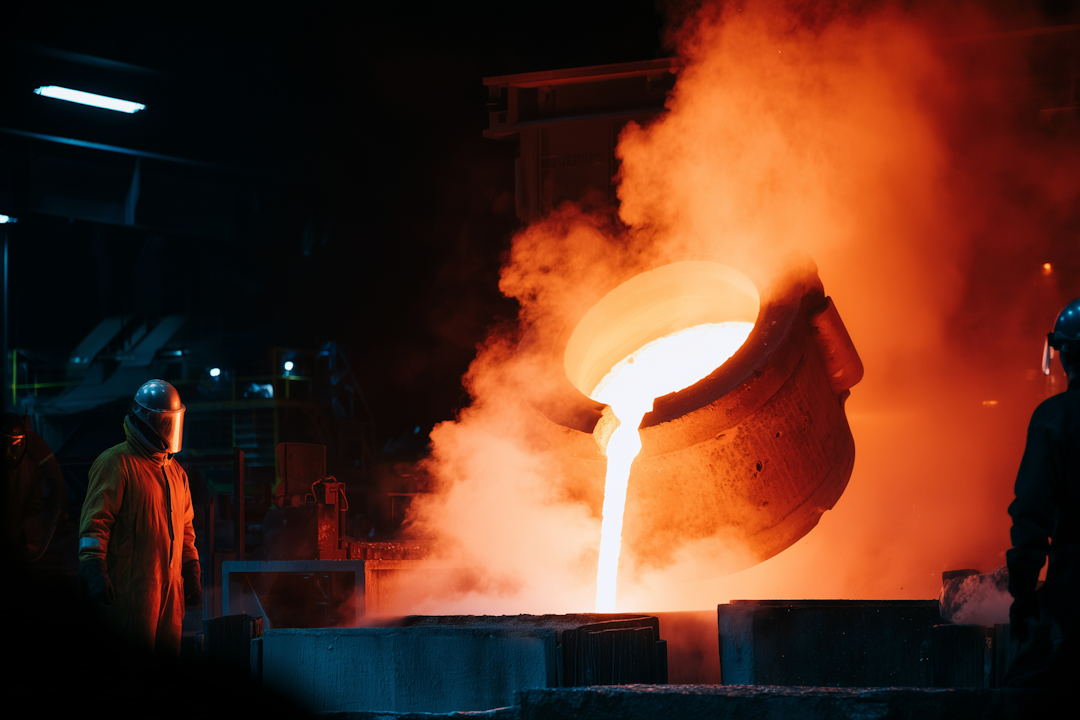
Molybdenum — commonly shortened to “moly” in the industry — is a metal that quietly strengthens much of the world’s critical infrastructure, from bridges and pipelines to power plants, while rarely attracting the same investor attention as gold, copper, or lithium. Its unusual production profile — heavily tied to copper mining as a byproduct rather than mined independently — also connects it directly to the copper market covered in our earlier explainer. Here is what molybdenum is actually used for and where it comes from.
The Short Answer
Molybdenum is primarily used as a steel alloying element, improving strength, hardness, and corrosion resistance even in small quantities. More than 80% of global molybdenum production goes into metallurgical applications. A significant share — more than 60% by some estimates — is recovered as a byproduct of copper mining rather than mined as a standalone primary commodity.
Molybdenum’s Core Role: Alloying Steel
Molybdenum’s primary industrial value comes from its role as an alloying agent — a metal added in relatively small quantities to significantly enhance the properties of another material, in this case steel. According to the International Molybdenum Association, molybdenum improves resistance to high-temperature creep (gradual deformation under stress), enhances structural stability across a wide temperature range, and increases fatigue resistance under repeated mechanical stress — properties that make it valuable across a wide range of steel grades.
Global consumption of molybdenum breaks down roughly as follows, according to Generation Mining: structural steel accounts for approximately 35%, stainless steel around 25%, chemical applications about 14%, tool and high-speed steels roughly 9%, cast iron around 6%, molybdenum elemental metal about 6%, and superalloys approximately 5%.
Why Infrastructure Depends on Molybdenum
Molybdenum-alloyed steel is specifically valued for infrastructure applications that must endure harsh environments over long operational lifespans — bridges, pipelines, power plants, and extensive transportation networks all rely on molybdenum’s contribution to durability and corrosion resistance. According to Farmonaut, more than 60% of mined molybdenum will be consumed by the infrastructure and energy sectors globally by 2026, reflecting the metal’s central but largely unheralded role in the built environment.
The oil and gas industry is also a significant consumer of molybdenum, both in drilling equipment and in pipelines — infrastructure that requires periodic replacement specifically to prevent spills, according to Generation Mining, making molybdenum-alloyed steel’s corrosion resistance directly relevant to environmental risk management in that sector.
Aerospace and High-Performance Applications
Beyond steel, molybdenum has important applications in aerospace and other high-performance engineering contexts. Molybdenum-copper alloys, for example, are used in aerospace applications combining molybdenum with elements like titanium, zirconium, hafnium, tungsten, and rare earth elements — alloying combinations that improve strength while maintaining low-temperature plasticity. Molybdenum’s exceptional strength at elevated temperatures also makes it valuable in jet engines, gas turbines, and industrial heat recovery systems, where long-term reliability under extreme thermal and mechanical stress is essential — applications that echo tungsten’s role in extreme-condition engineering, covered in our tungsten explainer.
The Byproduct Relationship With Copper Mining
A defining feature of the molybdenum supply chain is that more than 60% of global production is recovered as a byproduct of copper mining, rather than being mined as an independent primary target. Molybdenum is typically found combined with copper in porphyry deposits — the same large, low-grade deposits that are processed through froth flotation, covered in our flotation explainer, using a differential flotation stage specifically to separate copper and molybdenite into distinct concentrates.
This relationship means molybdenum supply is, to a meaningful degree, indirectly influenced by copper mining economics and investment decisions rather than by molybdenum-specific market signals alone. When copper mine expansions or new copper projects come online, molybdenum supply often increases as a secondary consequence, somewhat independent of molybdenum’s own price at the time — a dynamic similar to how cobalt production, covered in our cobalt explainer, is closely tied to copper and nickel mining decisions in the Democratic Republic of Congo.
Where Molybdenum Is Produced
Global molybdenum production has remained relatively stable at approximately 265,000 to 300,000+ metric tons annually. China and the United States together account for more than half of global production, according to Generation Mining, with Chile, Peru, and Mexico also significant producers. In the United States specifically, molybdenum production is concentrated in Colorado and Idaho, with the US accounting for roughly 18% of global production and producing more than 45,000 metric tons annually, according to Fortune Business Insights. Recycling contributes a meaningful share of total supply as well, estimated at nearly 30% in the US market.
Market Outlook
The global molybdenum market was valued at approximately $4.96 to $5.11 billion in 2025 and is projected to grow steadily — various industry estimates place 2026 market size between $5.23 and $5.36 billion, with continued growth projected through the early 2030s driven by expanding stainless steel production, infrastructure investment, oil and gas demand, and increased use in alloy steel manufacturing globally.
Key Takeaways for Investors
- Molybdenum’s primary use is as a steel alloying element, improving strength, corrosion resistance, and high-temperature performance — over 80% of production goes into metallurgical applications
- More than 60% of infrastructure and energy sector demand will drive molybdenum consumption by 2026, underpinning bridges, pipelines, and power generation infrastructure
- More than 60% of global molybdenum supply is recovered as a byproduct of copper mining rather than mined independently
- China and the US together account for more than half of global molybdenum production, with Chile, Peru, and Mexico also significant
- Because of the byproduct relationship, molybdenum supply is meaningfully influenced by copper mining investment decisions rather than molybdenum-specific price signals alone
- The global molybdenum market is valued at roughly $5 billion and is projected to grow steadily through the early 2030s
SOURCES
1. Fortune Business Insights — Molybdenum Market Size, Insights, Opportunities, Forecast: https://www.fortunebusinessinsights.com/molybdenum-market-114117
2. Farmonaut — Molybdenum Mines: 7 Key Global Trends for 2026: https://farmonaut.com/mining/molybdenum-mines-7-key-global-trends-for-2026
3. Generation Mining Limited — Molybdenum 101: https://genmining.com/investors/molybdenum-101/
4. Stanford Advanced Materials — How Molybdenum Is Used in Alloying: https://www.samaterials.com/content/how-molybdenum-is-used-in-alloying.html
DISCLAIMER
This article is an educational explainer based on publicly available industry data, market research, and published analyst commentary. Information was current as of the publication date noted below. Commodity price data and forecasts are sourced as cited and reflect market conditions at the time of writing.
Mining Markets Report has not received compensation from any company, institution, or organization in connection with this article.
Institutional price forecasts and analyst commentary referenced in this article represent third-party opinions at the time of publication and are not guarantees of future commodity performance.
The information provided is for informational and educational purposes only and does not constitute financial, investment, or professional advice. Readers are encouraged to conduct their own due diligence and consult a qualified financial advisor before making any investment decision.
For full terms, see our Disclaimer.